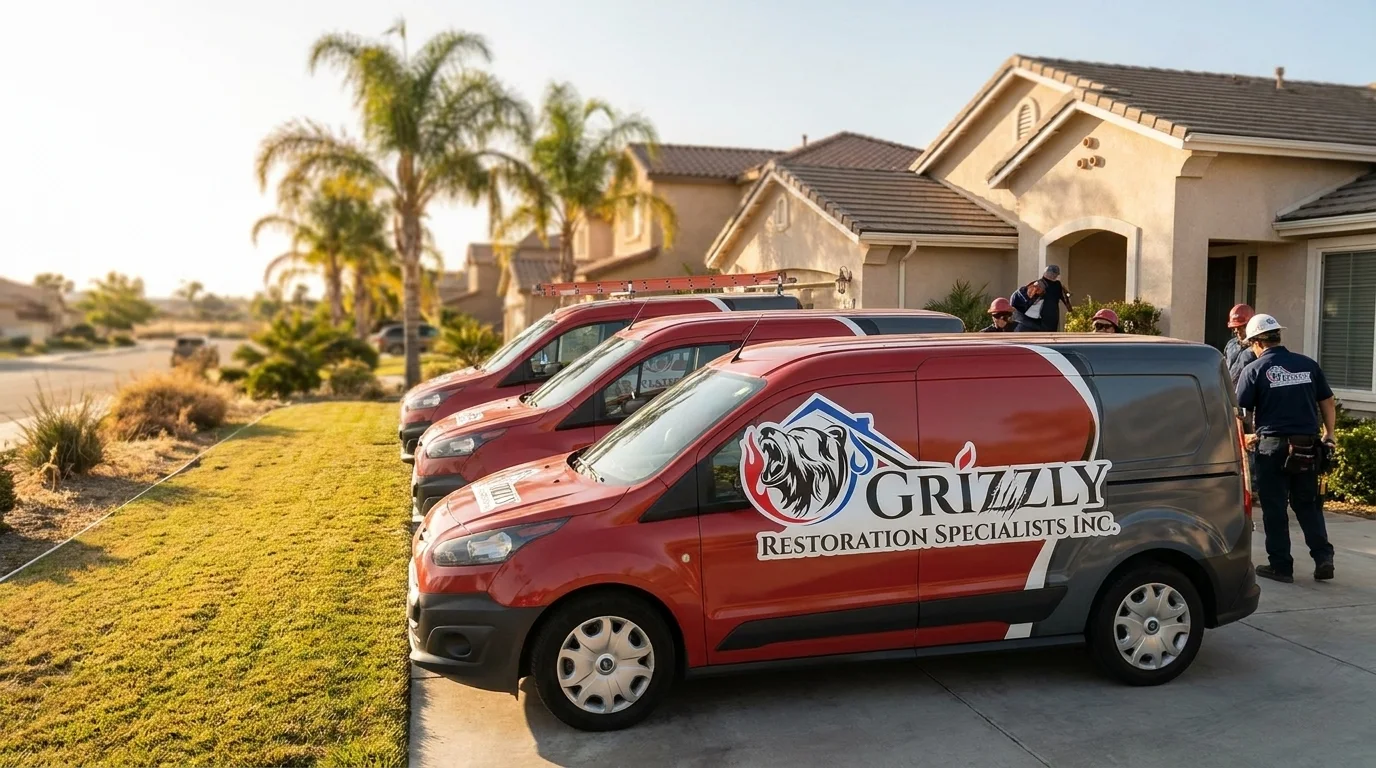
24/7 Emergency Water Damage Restoration in Fresno
24/7 emergency water damage restoration in Fresno and surrounding areas. IICRC-certified technicians, insurance billing accepted. Call (559) 417-5369.
Water damage emergency in Fresno? Call (559) 417-5369 now, we answer 24/7 and start extraction on arrival.
A supply line fails behind a dishwasher at 2 a.m., or a slab leak soaks through carpet pad while a family sleeps upstairs. Within hours, water wicks into drywall, swells baseboards, and starts moving toward framing members you can’t see. The clock that matters most isn’t the one on the wall, it’s the one mold spores are running: untreated moisture in wall cavities and subfloor can support colonization in as little as 24 to 48 hours. Fast, correct extraction and drying is the only way to stop that chain reaction before it becomes a bigger, costlier loss.
What water damage restoration actually involves
Water damage restoration is not a wet-vac and a box fan. It starts with identifying the water category (clean, gray, or black) because that classification determines what materials can be dried in place and what has to come out. Technicians use moisture meters, thermal imaging, and sometimes borescopes to map how far water has traveled under flooring, behind baseboards, and inside wall cavities, since surface-dry drywall can hide a soaked stud bay underneath. Extraction equipment removes standing water first, then commercial air movers and dehumidifiers are placed according to a drying plan, not just scattered around the room. For most residential losses, active structural drying runs three to five days, with daily moisture readings logged to confirm materials are actually losing water, not just drying on the surface while staying wet inside.
Our process
- Water extraction. Truck-mounted or portable extraction units pull standing and surface water fast, reducing how much moisture has time to migrate into subfloor and framing.
- Category and source assessment. Technicians confirm whether the water is clean, gray, or sewage-contaminated, which changes the materials that can be saved versus removed.
- Structural drying. Air movers and dehumidifiers are set per a calculated drying plan, targeting wall cavities, subfloor, and any trapped pockets identified during mapping.
- Moisture monitoring. Daily readings with moisture meters track drying progress against a target, so equipment isn’t pulled early just because carpet feels dry to the touch.
- Containment for Category 2/3 water. When the source is gray or black water, affected areas are contained and cross-contamination controls go up before any demolition or deep cleaning starts.
What separates a good water damage response from a bad one
The biggest mistake in water losses isn’t missed water, it’s water that was found but dried incorrectly. Pulling equipment too early because carpet feels dry, or skipping wall cavity checks because drywall looks fine from the outside, leaves hidden moisture that surfaces as mold or soft framing weeks later. Adjusters reviewing a claim want to see documented moisture logs, photos of affected materials before and after, and a clear equipment placement rationale, not just a final invoice. A careful response also distinguishes between materials that can be dried in place (solid wood subfloor, some drywall) and materials that should be removed (saturated insulation, particleboard, most carpet pad), since drying what should be replaced wastes time and still risks mold later.
What does water damage restoration cost?
Costs vary with water category, how far it traveled, and how many materials need removal versus drying in place. These are typical industry ranges, not a Grizzly Restoration quote, every loss gets its own written scope before work begins.
| Scenario | Typical range |
|---|---|
| Single room, clean water, caught early | $1,200 - $3,500 |
| Multi-room clean water with carpet removal | $3,000 - $7,500 |
| Category 2 (gray water) with drywall removal | $5,000 - $12,000 |
| Category 3 (contaminated water) with containment | $8,000 - $20,000+ |
| Hardwood floor removal and subfloor drying | $4,000 - $10,000 |
Most homeowners insurance policies cover sudden, accidental water damage such as a burst pipe or appliance failure, though coverage for gradual leaks or groundwater flooding is often limited or excluded, so it’s worth checking your specific policy language.
Seasonal & regional considerations
Fresno’s older housing stock, much of it built before modern slab and plumbing standards, means galvanized and copper supply lines are more prone to pinhole leaks as they age. Summer heat also means homes run air conditioning hard, and condensation lines or improperly sloped drain pans can quietly leak into ceilings and closets for weeks before a stain shows up. Winter brings fewer freeze risks here than colder climates, but irrigation line breaks and water heater failures still show up year-round.
Service area
Grizzly Restoration provides water damage restoration throughout Fresno, with technicians available to start extraction and drying work as soon as the source is identified.
If water is actively spreading through your home right now, don’t wait for it to find framing and subfloor on its own. Schedule your moisture assessment with Grizzly Restoration and get equipment on-site before the damage compounds.
Frequently Asked Questions
Does homeowners insurance cover water damage restoration?
How long does structural drying typically take for different categories of water?
How do you know if water has spread into walls or subfloor if the surface looks dry?
What's the difference between Category 1, 2, and 3 water damage?
What should I do while waiting for a water damage crew to arrive?
Looking for the best water damage restoration company in Fresno?
Grizzly Restoration provides licensed and insured water damage restoration in Fresno, CA and the surrounding area, and has served local property owners since 2023. Customers rate us 5.0 out of 5 stars across 4 Google reviews. We answer calls 24/7 — call (559) 417-5369 for immediate help.
Need Water Damage Restoration now?
We respond 24/7 across Fresno and surrounding CA cities.
Related Coverage
- Our Restoration Services
- Contact Grizzly Restoration
- 24/7 Emergency Water Removal & Cleanup in Fresno
- 24/7 Emergency Water Cleanup in Fresno
- Burst Pipe Emergency Checklist: Step-by-Step Response
- What To Do in the First 24 Hours After Water Damage
- How To Choose a Restoration Company in Fresno (Without Getting Burned)