The Short Answer
Most homeowners insurance policies cover water damage when it’s sudden and accidental, like a washing machine hose that bursts or a pipe that splits in a cold snap. They generally do not cover water damage that happens gradually, like a slow leak under a sink that’s been dripping for months, or damage from flooding caused by rising water, rain, or storm surge (that usually requires separate flood insurance). The difference between “covered” and “not covered” almost always comes down to one question: was this sudden, or was it something that could have been caught and fixed earlier?
What Your Policy Usually Covers
Standard homeowners policies (HO-3 is the most common form in California) typically cover water damage that’s classified as “sudden and accidental.” A few examples that usually fall into this category:
- A supply line to a toilet, dishwasher, or washing machine fails without warning
- A pipe bursts from age, pressure, or a hard freeze
- A water heater tank ruptures
- Water damage from firefighting efforts after a fire
- Accidental overflow from a tub or appliance
In these cases, your policy typically pays for both the water mitigation (extracting standing water, drying out structural materials) and the repair of damaged drywall, flooring, and cabinetry, minus your deductible. If the cause of the loss is also covered, like a burst pipe, most carriers will pay to open the wall to find and access it, though the cost of the plumbing repair itself is sometimes excluded depending on your policy language.
What’s Usually Excluded
This is where a lot of homeowners get an unpleasant surprise. Insurers draw a hard line around damage they consider preventable through normal maintenance. Commonly excluded:
- Gradual leaks. A slow drip from a supply line or a failing wax ring under a toilet that’s been seeping for weeks or months. Adjusters look for signs like swollen subfloor, rot, or mold growth that suggest the water has been present far longer than a single sudden event.
- Flood water. Water that enters from outside the home, rising groundwater, overflowing storm drains, or heavy rain pooling against a foundation, is a flood claim, not a homeowners claim. Flood coverage has to be purchased separately through the National Flood Insurance Program or a private flood policy.
- Lack of maintenance. If an adjuster determines the damage stems from a known issue you didn’t address (a leaking roof you’d been patching with a tarp, a water heater you knew was failing), the claim can be denied.
- Sewer and drain backups. Many standard policies exclude sewage or drain backup unless you’ve added a specific endorsement for it. This matters because sewage intrusion carries its own sanitation requirements separate from a typical clean-water loss.
- Mold, in some cases. If mold grows because of a covered water loss that was addressed promptly, many policies will cover the remediation up to a sublimit. If mold is tied to a long-term, unaddressed moisture problem, coverage is far less likely.
Immediate Steps After You Find Water
What you do in the first hour or two can affect both the extent of the damage and how smoothly your claim goes.
- Stop the source if you can. Shut off the fixture’s local valve or the home’s main water shutoff if the source isn’t obvious.
- Shut off electricity to the affected area if water is near outlets, switches, or light fixtures, and you can do so safely at the panel.
- Photograph everything before you move or touch anything. Standing water, wet flooring, swollen baseboards, the source of the leak itself. This documentation is what your adjuster will reference.
- Move what you can out of standing water. Furniture legs, rugs, boxes, electronics. This limits secondary damage and shows the insurer you took reasonable steps to prevent loss from worsening.
- Call your insurance company to open a claim, and ask what documentation they need from a restoration contractor.
What Not to Do
- Don’t wait to see if it dries on its own. Drywall, subfloor, and insulation that stay wet for more than a day or two create the conditions mold needs to begin colonizing, and that delay can also be used to argue the damage wasn’t promptly mitigated.
- Don’t throw away damaged materials before documenting them. Adjusters want to see the extent of the loss, not just a verbal description of it.
- Don’t run a household fan and call it dry. Surface-dry is not the same as structurally dry. Carpet pad, subfloor, and wall cavities can hold moisture long after the surface feels fine to the touch, and that hidden moisture is exactly what leads to mold and rot later.
- Don’t assume your contractor and your adjuster are seeing the same thing. Ask whichever restoration company you bring in to document moisture readings as they work, not just before and after photos.
When to Call a Professional
If the water came from a clean source (a supply line, a burst pipe, an appliance) and it’s limited to a small area you can dry yourself within a day, a shop vac and some fans might genuinely be enough. Call a restoration company when:
- Water has reached subfloor, insulation, or wall cavities
- The water has been sitting for more than 24 hours
- You’re not sure how far the water traveled (it often travels farther than the visible stain suggests)
- The source involved a sewer backup or contaminated water
- You need documentation that satisfies your insurance company’s requirements
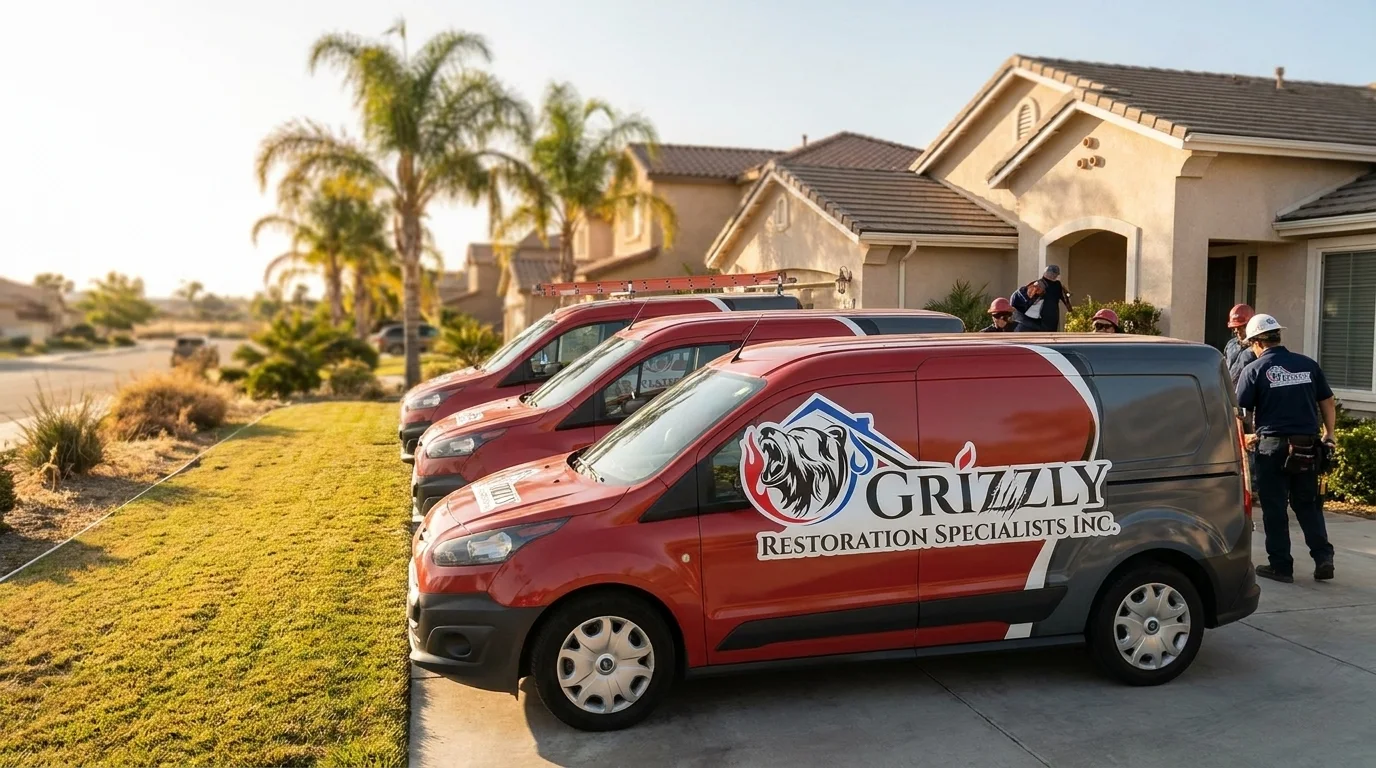
Grizzly Restoration’s technicians hold IICRC Water Damage and Structural Drying certifications and use moisture meters and thermal imaging to track water behind walls and under flooring, not just what’s visible. That documentation, moisture logs, photos, and drying progress reports, is often what separates a smooth claim from a disputed one.
The Recovery Process
Once the source is stopped and the claim is open, recovery generally moves through three phases: extraction of standing water, structural drying with air movers and dehumidifiers set up to the IICRC S500 standard, and finally repair of whatever was damaged, drywall, flooring, cabinetry, trim. Drying typically takes a few days of monitoring, not hours, because materials like subfloor and framing lumber release moisture slowly even after the surface feels dry. A restoration company documenting that process gives your adjuster the data they need to close the claim without a second visit.
If you’re dealing with water damage in a Fresno home right now and aren’t sure whether it’s a DIY job or something that needs documentation for a claim, Grizzly Restoration can walk the property, assess the extent of the moisture, and lay out what your options are before you decide. Call (559) 417-5369.