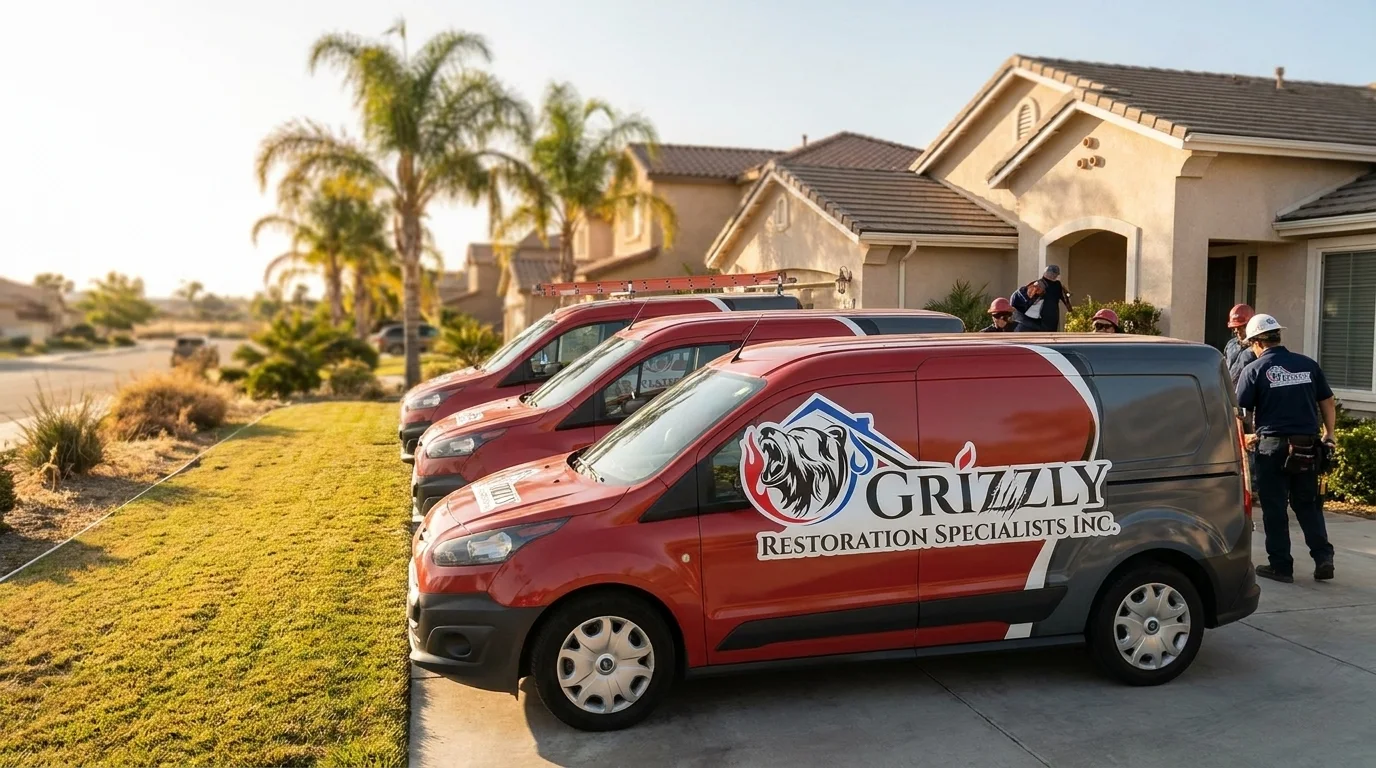
24/7 Emergency Water Heater Flood Cleanup in Fresno
24/7 emergency water heater flood cleanup in Fresno and surrounding areas. IICRC-certified technicians, insurance billing accepted. Call (559) 417-5369.
Water heater burst or leaking into your garage, closet, or crawlspace? Call (559) 417-5369. We answer 24/7, because a failed tank doesn’t wait for business hours and neither does the water spreading under your flooring.
A water heater failure rarely gives warning. Tanks corrode from the inside out, and by the time you notice water pooling at the base, the unit may have been weeping for weeks or let go all at once. Either way, the water finds the path of least resistance: under baseboards, into adjacent drywall, down through subfloor seams, and into whatever sits below, whether that’s a slab, a crawlspace, or a finished basement. Fresno homes with water heaters in interior closets or upstairs utility rooms often see the worst secondary damage, since gravity carries the water through ceilings and walls before anyone finds the leak.
What Water Heater Flood Cleanup actually involves
The work starts with identifying how much water escaped and where it traveled, not just where it’s visible. A 40 or 50 gallon tank failure can release its full volume in minutes, and that water doesn’t stay in one room. We extract standing water first, then pull affected baseboards, cut access where drywall has wicked moisture, and check subfloor and insulation in the cavity below. Moisture meters and thermal imaging map how far the water actually spread, which is almost always further than the visible stain. Depending on how long the water sat and what it touched, drying equipment stays in place anywhere from a few days to over a week, with moisture readings tracked daily until materials return to normal range.
Our process
- Source confirmation and water shutoff check. Before cleanup starts, we confirm the water heater is isolated so you’re not drying a room that’s still taking on water.
- Extraction and material assessment. We remove standing water and determine which materials, flooring, baseboard, drywall, subfloor, can be dried in place and which need to come out.
- Controlled demolition where needed. Saturated drywall below the flood line, swollen baseboard, and compromised subfloor are removed to stop trapped moisture from sitting behind finished surfaces.
- Structural drying and monitoring. Air movers and dehumidifiers are set per the affected square footage, and moisture content is checked daily against dry standard until the space clears.
- Documentation for your claim. Photos, moisture logs, and a written scope of the affected materials are compiled throughout, not reconstructed afterward.
What separates a good water heater flood response from a bad one
The most common mistake is drying only what’s visible. A tank failure in a closet with tile flooring can look contained on the surface while water has already migrated under the tile, into the subfloor, and along the baseboard into the next room. Surface-drying that cavity without checking adjacent walls leaves hidden moisture that shows up as a mold or odor problem weeks later. A second common gap is skipping the shutoff valve and supply line check, cleanup that ignores whether the leak is actually stopped risks drying a space that’s still absorbing water. Adjusters reviewing water heater claims typically look for moisture logs showing the drying progression, clear photos of the source and the spread pattern, and a scope that distinguishes what was removed versus dried in place, that documentation is what moves a claim along instead of stalling it.
What does Water Heater Flood Cleanup cost?
Costs vary with how far the water traveled, what materials were affected, and how long the leak went undetected before discovery. These are typical industry ranges, not a quote, every loss is different and Grizzly Restoration provides a written scope before any work begins.
| Scenario | Typical range |
|---|---|
| Contained leak, tile or vinyl flooring only | $800 - $2,200 |
| Water heater closet plus adjacent room, drywall and baseboard affected | $2,000 - $5,500 |
| Multi-room spread with subfloor removal | $4,500 - $9,000 |
| Upstairs unit with ceiling and floor damage below | $6,000 - $14,000 |
| Undetected slow leak, extended saturation and material replacement | $8,000 - $18,000+ |
Homeowners insurance typically covers sudden water heater failures as a covered peril, though coverage can narrow if the leak is found to be the result of long-term neglect or a tank well past its expected service life, which is something your adjuster will usually ask about directly.
Seasonal & regional considerations
Fresno’s dry summer heat and hard water can accelerate tank corrosion and sediment buildup, which shortens the lifespan of water heaters across the valley and makes sudden failure more common in units past the ten-year mark. Homes built on slab foundations, common throughout much of Fresno, tend to trap water heater leaks against the slab edge, where it can travel further before surfacing as a visible stain.
Service area
Grizzly Restoration responds to water heater flood cleanup calls throughout Fresno.
If your water heater has failed and water is spreading into your flooring or walls, don’t wait for it to dry on its own, hidden moisture behind baseboard and under subfloor rarely does. Call (559) 417-5369 to schedule your water heater flood cleanup and get a written scope before anything is torn out.
Frequently Asked Questions
Does homeowners insurance cover water heater flood cleanup?
How do I know if my water heater leak has spread beyond what I can see?
Do you remove and replace the water heater itself?
How long does drying take after a water heater floods a closet or utility room?
What should I do while waiting for a water heater flood cleanup crew?
Looking for the best water heater flood cleanup company in Fresno?
Grizzly Restoration provides licensed and insured water heater flood cleanup in Fresno, CA and the surrounding area, and has served local property owners since 2023. Customers rate us 5.0 out of 5 stars across 4 Google reviews. We answer calls 24/7 — call (559) 417-5369 for immediate help.
Need Water Heater Flood Cleanup now?
We respond 24/7 across Fresno and surrounding CA cities.